Understanding the Internet of Things (IoT): Smart Devices in Our Daily Lives

Understanding the Internet of Things (IoT): Smart Devices in Our Daily Lives

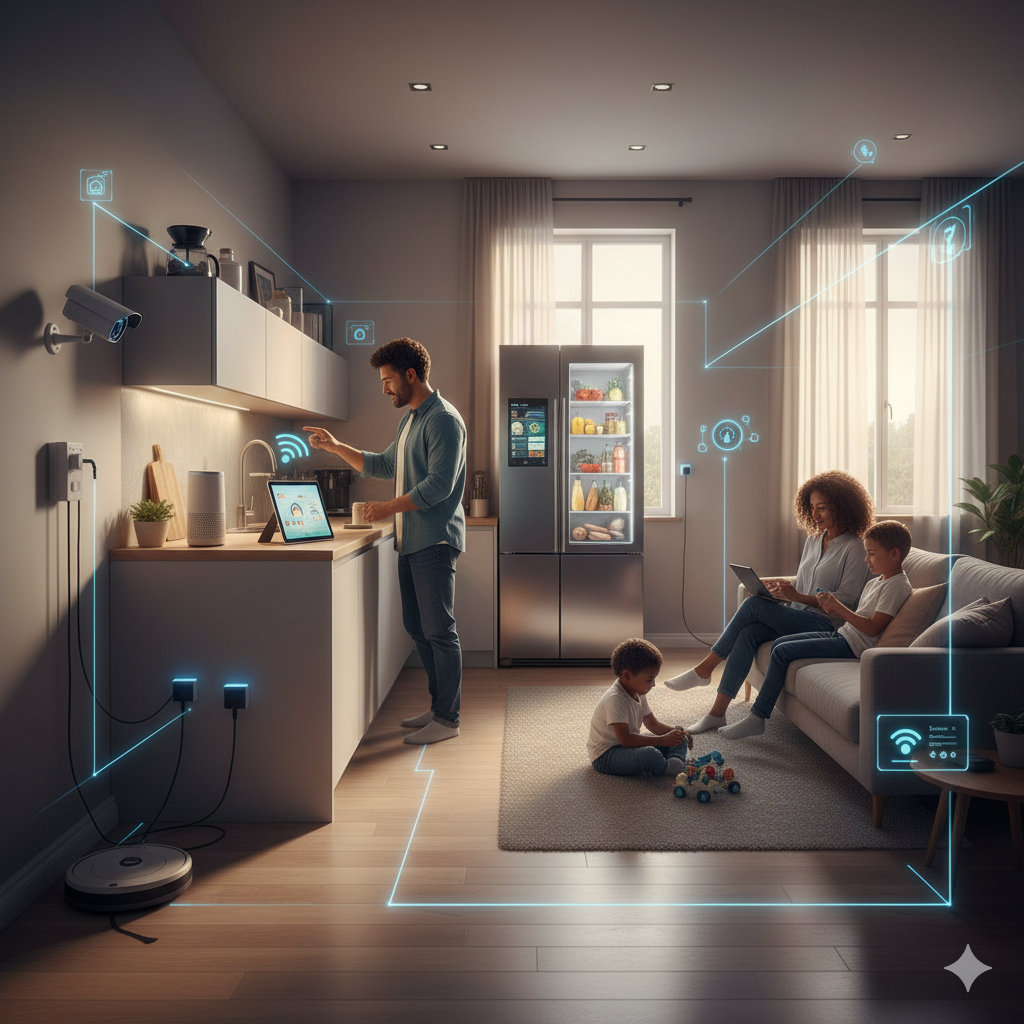
The Internet of Things (IoT) refers to everyday objects that are connected to the internet and can send or receive data. These devices are called “smart” devices because they can work automatically, communicate with each other, and make our lives easier.

In simple terms, IoT allows ordinary devices to connect, share information, and respond without human intervention.

What Are Smart Home Devices?

Smart home devices are one of the most common examples of IoT. These devices are used in our homes and can be controlled through smartphones or voice assistants.

Examples include:

Smart lights that turn on or off using an app or voice command

Smart thermostats that adjust room temperature automatically

Smart security cameras and door locks that improve home safety

These devices help save time, increase comfort, and improve energy efficiency.

What Are Wearable Devices?

Wearables are smart devices that people wear on their bodies. They are designed to monitor health, fitness, and daily activities.

Common wearable devices include:

Smartwatches that track steps, heart rate, and sleep

Fitness bands that monitor exercise and calories burned

Wearables collect data and give users helpful insights about their health and lifestyle.

What Are Connected Devices?

Connected devices include any objects that can connect to the internet and communicate with other systems.

Examples include:

Smart refrigerators that track food items

Connected cars that provide navigation and safety features

Smart TVs and speakers that stream content and respond to voice commands

These devices work together to create a more efficient and connected environment.

Why Is IoT Important?

IoT makes everyday life:

More convenient – tasks can be automated

More efficient – energy and time are saved

More informed – users receive real-time data

IoT is not only used in homes but also in healthcare, transportation, agriculture, and cities.

Challenges of IoT

Despite its benefits, IoT also has challenges:

Privacy and data security risks

Dependence on internet connectivity

Compatibility between different devices

These challenges highlight the importance of strong security and responsible use.

Conclusion

The Internet of Things is changing the way we live and interact with technology. From smart homes and wearables to connected devices, IoT is becoming part of everyday life. As technology continues to grow, IoT will play an even bigger role in creating smarter and more connected communities.

10 Perspectives on the 2026 Tech Takeoff

We often talk about technology in terms of ‘specs’—gigawatts, base pairs, and parameters. But in 2026, the story has changed. We aren’t just building better tools; we are rewriting the fundamental scripts of how we live, how we think, and what it means to be human

1. The “Data Colony” Conflict
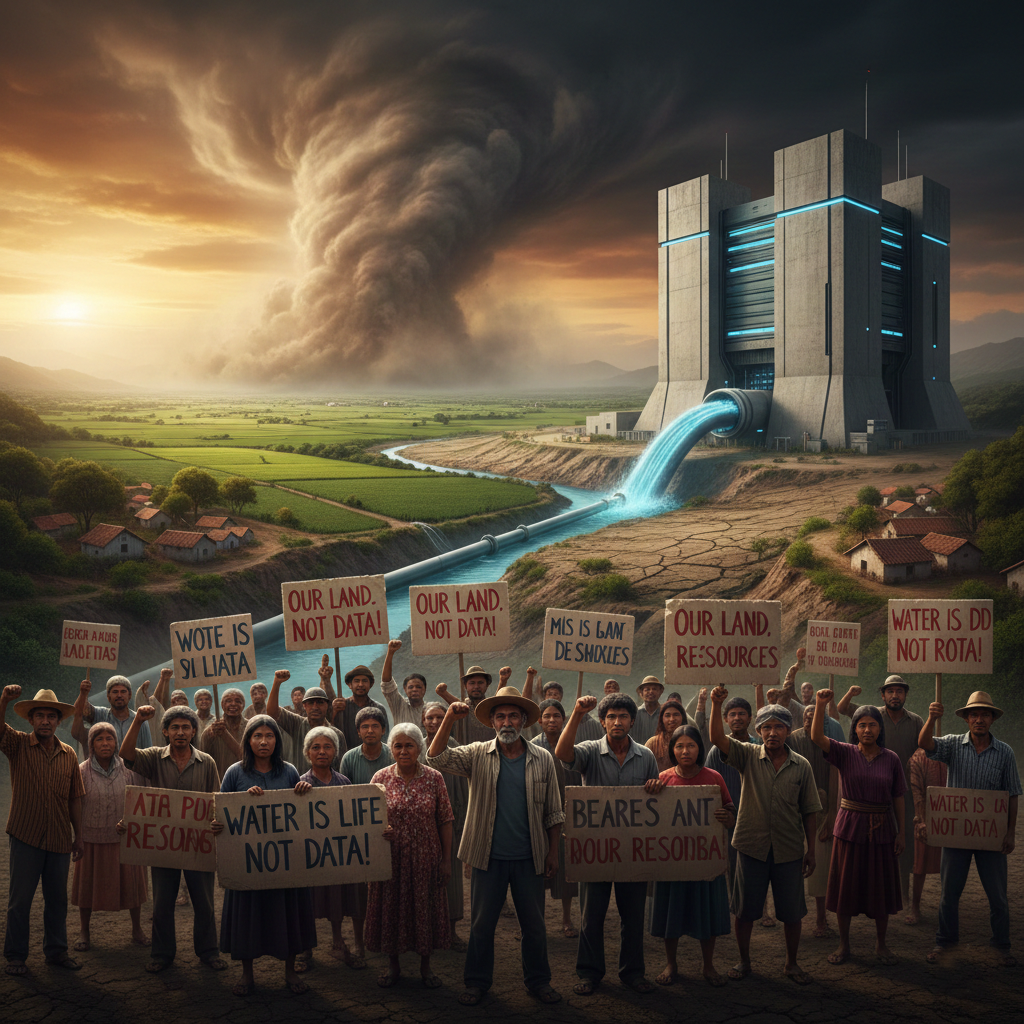
Hyperscale AI Data Centers The Angle: While the world focuses on the output of AI, a new geopolitical friction is emerging over its physical footprint.

Unique Idea: Explore the “Resource Sovereignty” movement, where local communities are beginning to protest data centers that consume up to 500,000 gallons of water daily. The article could profile “Data Refugees”—small towns where rising utility costs are driven by AI’s thirst, creating a tension between global progress and local survival.

2. The Death of the “Syntax Error”
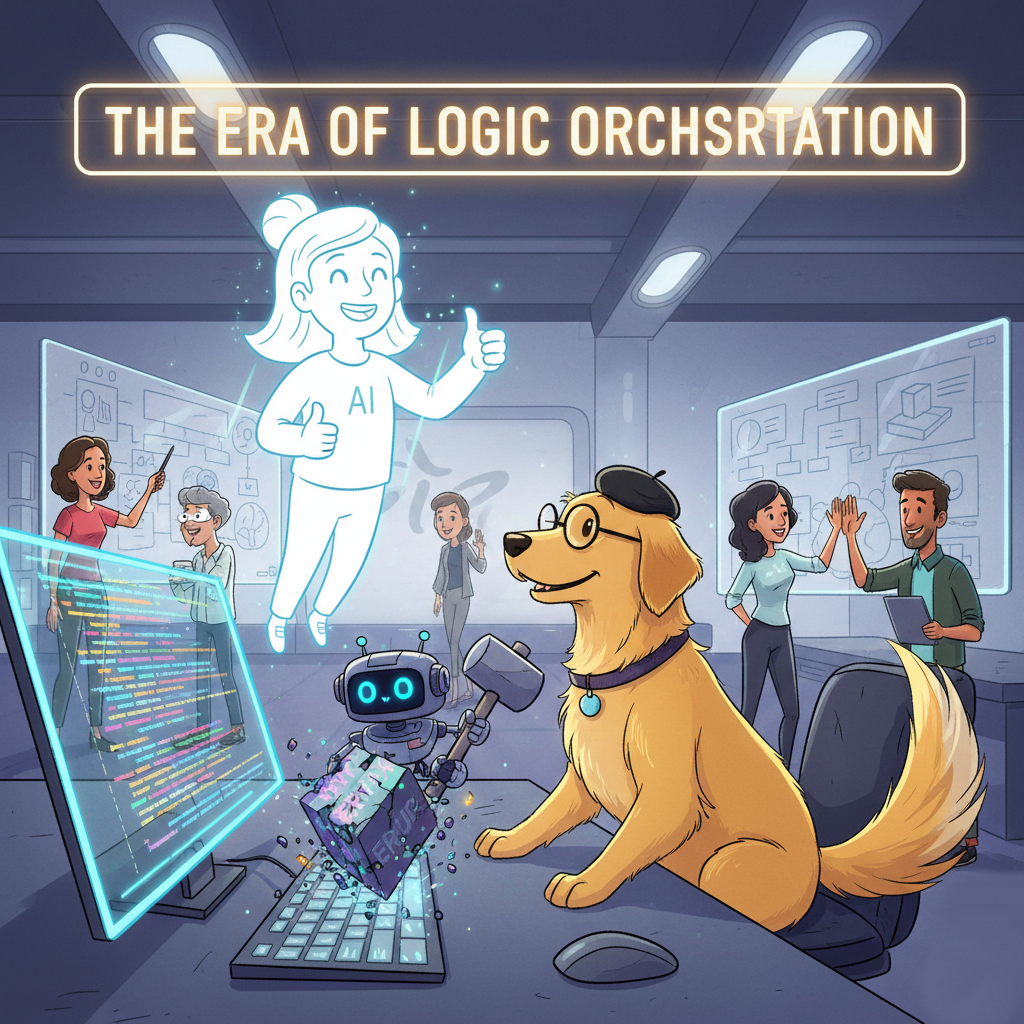
Generative Coding The Angle: We are moving from the era of “Writing Code” to the era of “Orchestrating Logic.”

Unique Idea: Instead of focusing on job loss, this article would explore the Rise of the “Product Architect.” As AI handles the rote syntax, the most valuable engineers are no longer those who can code the fastest, but those who can define the most complex problem structures. It’s a shift from being a “worker in the factory” to being the “factory designer.”

3. The Salt Revolution: Breaking the Lithium Monopoly
Sodium-Ion Batteries the Angle: Sodium-ion isn’t just a battery upgrade; it’s a geopolitical equalizer.


Unique Idea: Investigate how countries without lithium reserves (but with vast coastlines or salt flats) are using sodium-ion technology to bypass the “Lithium Opec.” This article could focus on the “Democratization of the EV,” where $10,000 electric cars finally become viable for the Global South, shifting the balance of economic power.

4. The “AI Lie Detector” and the End of Hallucination
AI Mechanistic Interpretability The Angle: Moving from “Trust me” to “Show me the math.”

Unique Idea: Profile the “AI Forensic Accountants”—a new class of researchers using mechanistic interpretability to build “Neural Lie Detectors.” The article would explore a future where AI systems are legally required to provide a “Decision Trace” before being used in courts or hospitals, effectively ending the era of the “Black Box.”

5. Atoms for Algorithms: The “Nuclear-AI” Symbiosis
Advanced Nuclear Reactors The Angle: The tech giants of Silicon Valley are becoming the power utilities of the future.

Unique Idea: Deep-dive into the “Corporate Grid” phenomenon. Companies like Microsoft and Amazon are now funding their own Small Modular Reactors (SMRs). The article explores the risks of a “decoupled” energy system where the world’s most powerful AI models run on private, carbon-free islands of energy while the public grid continues to struggle with aging infrastructure.

6. N=1: The Era of the Single-Patient Miracle
Customized Base Editing The Angle: Medicine is moving from “Mass Market” to “Mass Personalization.”

Unique Idea: Follow the journey of a family receiving a “One-Off Cure.” This article would highlight the regulatory nightmare: How do you “approve” a drug that will only ever be used by one person? It shifts the focus from pharmaceutical profits to a future where “software-defined medicine” can fix a single DNA letter for a single life.

7. The New “Genetic Divide”
Polygenic Embryo Screening The Angle: The ultimate insurance policy—or the ultimate inequality?

Unique Idea: Rather than a “designer baby” trope, focus on the “Health Insurance Gap.” Imagine a future where insurance premiums are lower for children who were screened for heart disease risk at the embryo stage. The article would explore how “Genetic Gaps” could become the new “Wealth Gaps,” creating a biological class system.

8. The Ghost in the Heart: AI and the Loneliness Economy
AI Emotional Companionship The Angle: Is an AI “friend” a bridge to human connection, or a replacement for it?

Unique Idea: Investigate the “Post-Human Social Fabric” of Gen Alpha. This article would profile “Hybrid Friendships,” where children grow up with AI companions that remember every secret and never get tired of playing. It asks the haunting question: If an AI provides perfect empathy, will we still have the patience for the “messiness” of human friends?

9. Zero-G Factories: The Orbital Gold Rush
Commercial Space Stations The Angle: The next Industrial Revolution won’t happen on Earth.

Unique Idea: Focus on “Exo-Manufacturing.” Certain medicines and fiber-optic cables can only be made perfectly in microgravity. The article would paint a picture of “Orbital Industrial Parks”—not as places for astronauts, but as highly automated factories where the next trillion-dollar products are “grown” in the vacuum of space.

10. The Ethics of “Resurrection Ecology”
Gene Resurrection The Angle: We can bring back the past, but should we?

Unique Idea: Explore the “Ecological Ghost” concept. Bringing back a mammoth or an ancient plant is one thing; finding a place for it in a 2026 climate is another. This article would focus on the “Bio-Zoos” of the future and whether “Gene Resurrection” is a genuine tool for conservation or just a high-tech distraction from the extinctions we are causing today.


What Should you Know about: Tesla Cybertruck

🛻 What is the Tesla Cybertruck?

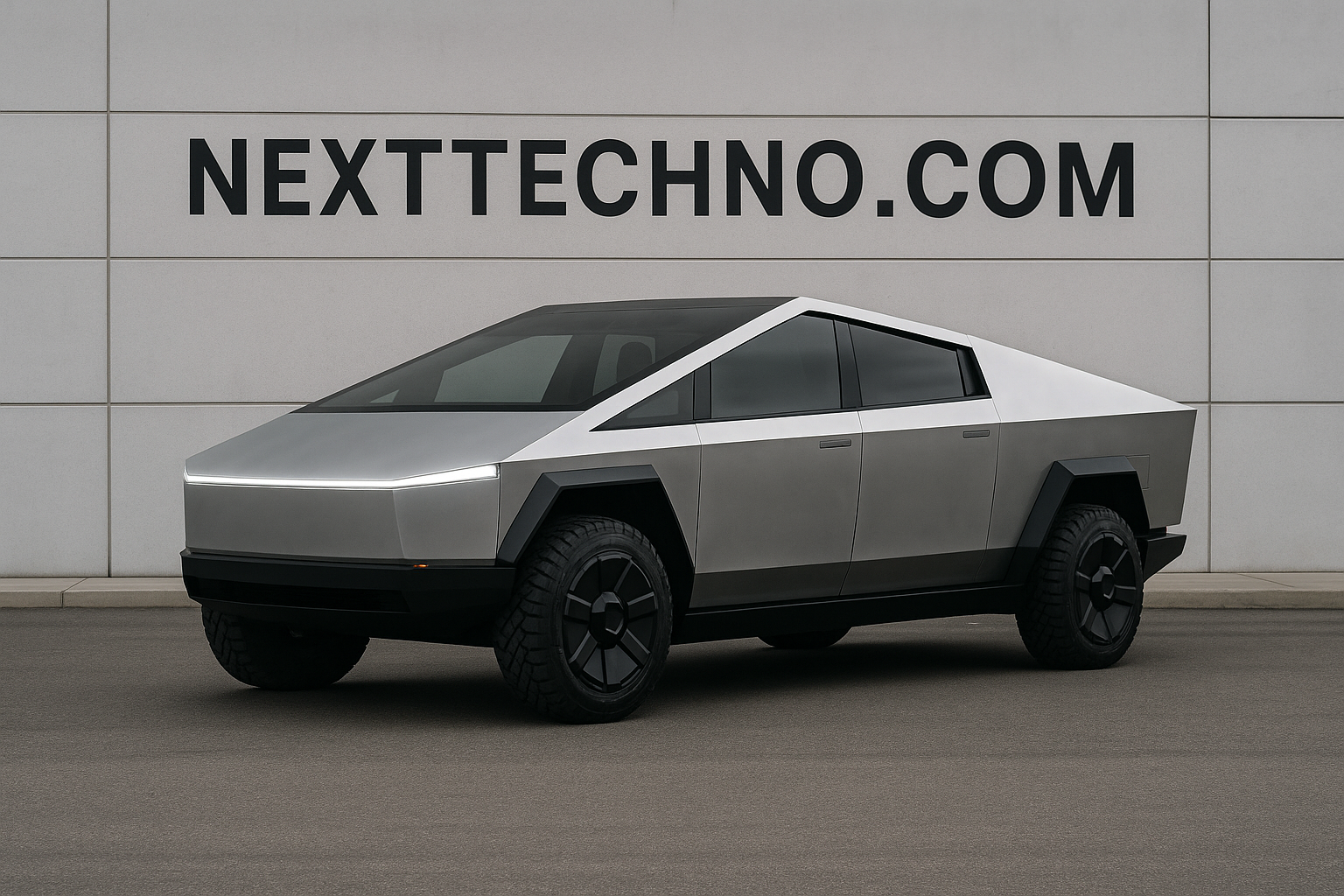
The Tesla Cybertruck is an electric pickup truck made by Tesla, the same company that makes electric cars like the Model 3 and Model Y. It’s designed to look futuristic, like something from a sci-fi movie.

🔩 What Makes It Special?

  1. Strong Body
    The Cybertruck is made of stainless steel, the same kind used in rockets. This makes it very strong and tough. Tesla even said it’s “bulletproof” to some small guns.
  2. Electric Power
    It runs on electricity, not gas. That means it’s better for the environment and doesn’t produce pollution.
  3. Fast for a Truck
    Even though it’s big and heavy, it can go from 0 to 60 mph in under 3 seconds (depending on the model). That’s as fast as some sports cars!
  4. Big Battery, Long Range
    It can drive up to about 340 miles on a full charge (on some versions), which is good for long trips.
  5. Can Tow and Haul
    It’s strong enough to tow heavy trailers and carry large loads, just like a regular pickup truck.
  6. Unique Design
    The shape is very different from normal trucks—it’s sharp and angular. Some people love it, others don’t.

💰 How Much Does It Cost?

There are a few versions:

  • Rear-wheel drive: Cheapest, less powerful (expected late 2025)
  • All-wheel drive: Middle option, most popular
  • Cyberbeast: Most powerful and expensive version

Prices range from around $60,000 to $100,000+, depending on features.


🤖 Cool Features

  • Autopilot: Helps with driving, like staying in your lane and following other cars.
  • Large touchscreen inside to control everything.
  • Can be used to power tools or even a house during a power outage.
  • Adjustable suspension for different road conditions.

🛠️ Is It Available Now?

Tesla started delivering the first Cybertrucks in late 2023, but only a small number have been made so far. More will come out in 2024 and 2025.

👍 Pros

  • Strong and durable
  • Fast and powerful
  • Long range
  • Eco-friendly (electric)

👎 Cons

  • Expensive
  • Design not for everyone
  • Limited availability for now


Switch 2 problem

What’s the Problem with the Nintendo Switch 2?

So, everyone’s been super excited about the Nintendo Switch 2 — the follow-up to the hugely popular original Switch. But there are a couple of problems popping up that make fans a bit worried:


  1. Delays, Delays, Delays

People were expecting Switch 2 to come out in 2024, but now it looks like it might not drop until early 2025. That’s a long wait, especially since Nintendo hasn’t said much officially. It’s frustrating when you’re hyped and left hanging!


  1. Will It Be Powerful Enough?

There are rumors that the Switch 2 won’t be as powerful as the PS5 or Xbox Series X. Some people worry it might struggle with newer games or won’t feel like a true “next gen” console. Basically: “Will it be just another small upgrade?”


  1. Maybe A Backwards Compatibility?

Fans really want to play their old Switch games on the new console. Some reports say it’ll support that; others aren’t so sure. If it doesn’t, people won’t be happy having to rebuy games they already own.


  1. Price Concerns

If Switch 2 has better hardware, it’ll probably be more expensive. But how much more? People love the Switch partly because it’s affordable. If the new one costs too much, it could turn some buyers off.


TL; DR:

The Switch 2 sounds exciting, but fans are worried about delays, power, price, and whether their old games will still work. Everyone’s hoping Nintendo gets it right — but for now, we’re stuck waiting and guessing.


Should You Update? iOS 18.5 ?

Security: Over 30 Major Fixes

iOS 18.5 comes packed with more than 30 important security patches, making it a must-have update for all iPhone users. It closes off several potential vulnerabilities that could be exploited, so updating helps keep your device safe and secure.

🌐 New Features: Better Functionality

  1. Satellite Connectivity for iPhone 13
    iPhone 13 users can now use satellite-based messaging through carriers like T-Mobile. However, the Emergency SOS via Satellite feature still remains exclusive to iPhone 14 and newer.
  2. Mail App Improvements
    The “All Mail” view is back, making it easier to see all your emails in one place. You can also now hide contact photos directly from the Mail app—great for a cleaner look.
  3. Screen Time Alerts for Parents
    Parents will now get a notification if their kid enters the passcode to disable Screen Time restrictions. Handy for keeping an eye on device use!
  4. New “Pride Harmony” Wallpaper
    To celebrate Pride Month, Apple added a new “Pride Harmony” wallpaper so users can show support and customize their home screen.
  5. Easier Purchases in Apple TV App
    The “Buy with iPhone” feature is now available in the Apple TV app on third-party devices, letting you confirm purchases right from your iPhone.
  6. Clearer Warranty Info
    You can now check your device’s warranty status and AppleCare+ coverage right in the Settings app. Super convenient.


⚙️ Performance and Stability: Smoother Experience

Many users have noticed better performance and fewer bugs after updating to iOS 18.5—issues like black screens when opening the camera and frozen apps have reportedly been fixed. But not all feedback is positive—some iPhone 16 Pro users are seeing battery drain and frequent app crashes

📱 Should You Update?

If you’ve got an iPhone 13 and want satellite messaging, or you’re interested in new features like improved parental controls and easier Apple TV purchases, this update is definitely worth it.
But if you’re on an iPhone 16 Pro, you might want to hold off a bit or do some research first—there are reports of performance issues on that model.